
The Compounding Magic of Reinvesting Your Dividends

Receiving a dividend payment feels like a small victory. It's tangible proof that your ownership in a company is generating a return. Many investors simply take this cash and spend it.
But what if that small victory could be turned into a much larger one?
The most successful long-term investors understand a simple truth: the real power isn't just in earning dividends, but in what you do with them next. This is where the patient, methodical process of reinvesting comes into play.
Understanding the Two Choices
When a company you've invested in pays a dividend, you have a choice. You can take the cash, or you can reinvest it. Think of it as a reward from the company for being a shareholder-a slice of the profits.

Taking the cash provides immediate income. Reinvesting, however, puts that money straight back to work for you. It's a disciplined approach that can dramatically alter your financial trajectory over time.
The Snowball Effect
The principle at work here is compounding. Imagine a small snowball at the top of a very long, snowy hill. As it starts rolling, it picks up more snow, growing larger. The larger it gets, the more snow it collects with each rotation, accelerating its growth.
Reinvesting dividends works the exact same way.
Here's the process:
- Your shares pay you a dividend.
- That dividend money is used to automatically purchase more shares of the same stock.
- Now you own more shares.
- The next time a dividend is paid, it's calculated on your larger number of shares, resulting in a bigger dividend payment.
- That bigger payment buys even more shares.
This cycle repeats, creating a powerful, self-fueling loop of growth. It's a quiet force that builds wealth not through frantic trading, but through patience and consistency.
Automating Growth with DRIPs
Manually reinvesting every small dividend payment would be tedious. Fortunately, there's a system for that: the Dividend Reinvestment Plan, or DRIP.
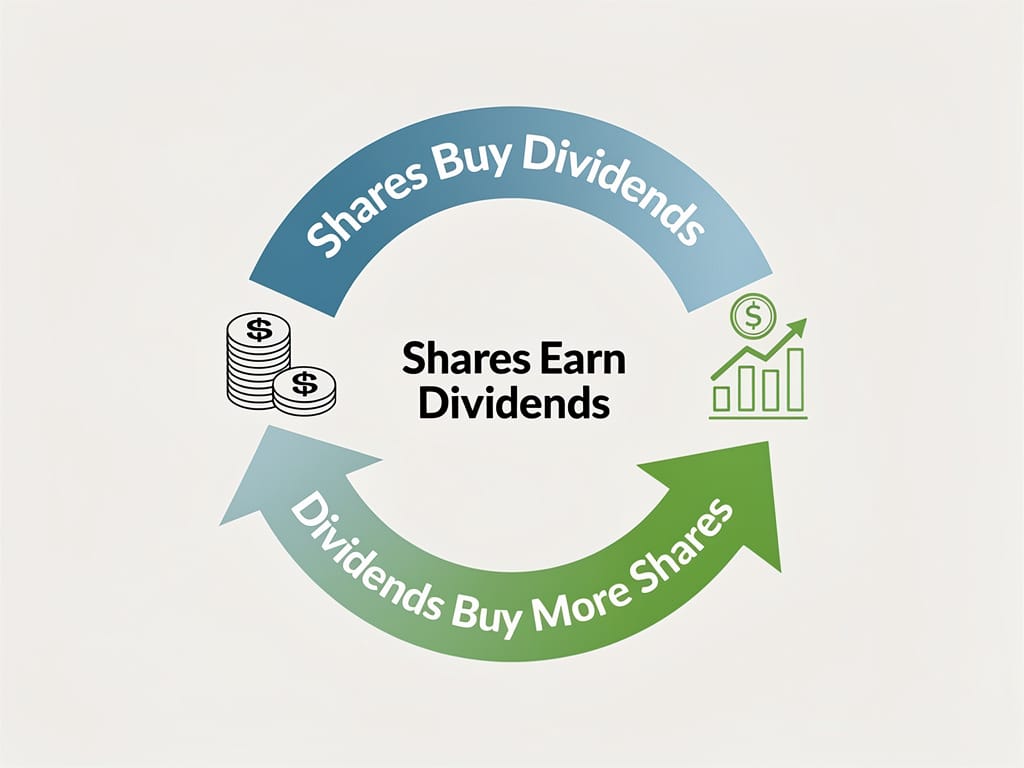
A DRIP is an automated program offered by most brokerages or directly by the companies themselves. When you enroll, your cash dividends are automatically used to buy more stock without you lifting a finger.
DRIPs offer several distinct advantages:
- It's Automatic: The process is hands-off. This removes emotion and the temptation to spend the dividend cash, enforcing a disciplined investment strategy.
- Dollar-Cost Averaging: Because you're buying stock at regular intervals (every time a dividend is paid), you're buying at different price points. This can smooth out your average cost per share over the long run.
- Fractional Shares: DRIPs allow you to own fractions of a share. This means every single cent of your dividend is put to work, rather than sitting idle waiting for you to accumulate enough cash to buy a full share.
A Word on Practicality
While powerful, this strategy requires a long-term perspective. The effects of compounding are subtle at first but become immense over decades. It's not a get-rich-quick scheme; it's a get-wealthy-slowly system.
It's also important to remember the nature of the underlying investment. Reinvesting dividends into a high-quality, stable company with a history of consistent payouts is a sound strategy. Reinvesting into a speculative or failing business simply means you're buying more of a bad investment.
Finally, be aware of taxes. In a standard brokerage account, you will owe taxes on the dividends you receive, even if you reinvest them. These are typically handled within retirement accounts like a 401(k) or IRA differently, so it's good to know the rules for your specific account type.
The principle of compounding is one of the most powerful and reliable forces in finance. By reinvesting your dividends, you are not just an investor; you are actively building your own wealth-generating machine, one share at a time.
The choice is simple. You can treat your dividends as a small bonus today, or you can plant them as seeds for a much larger harvest tomorrow.